| Item Number: | 12262 |
| Year: | 1783 |
| City of edition: | Madrid |
| Size: | 18x13cm |
[Albacete] Vista oriental de la ciudad de Chinchilla
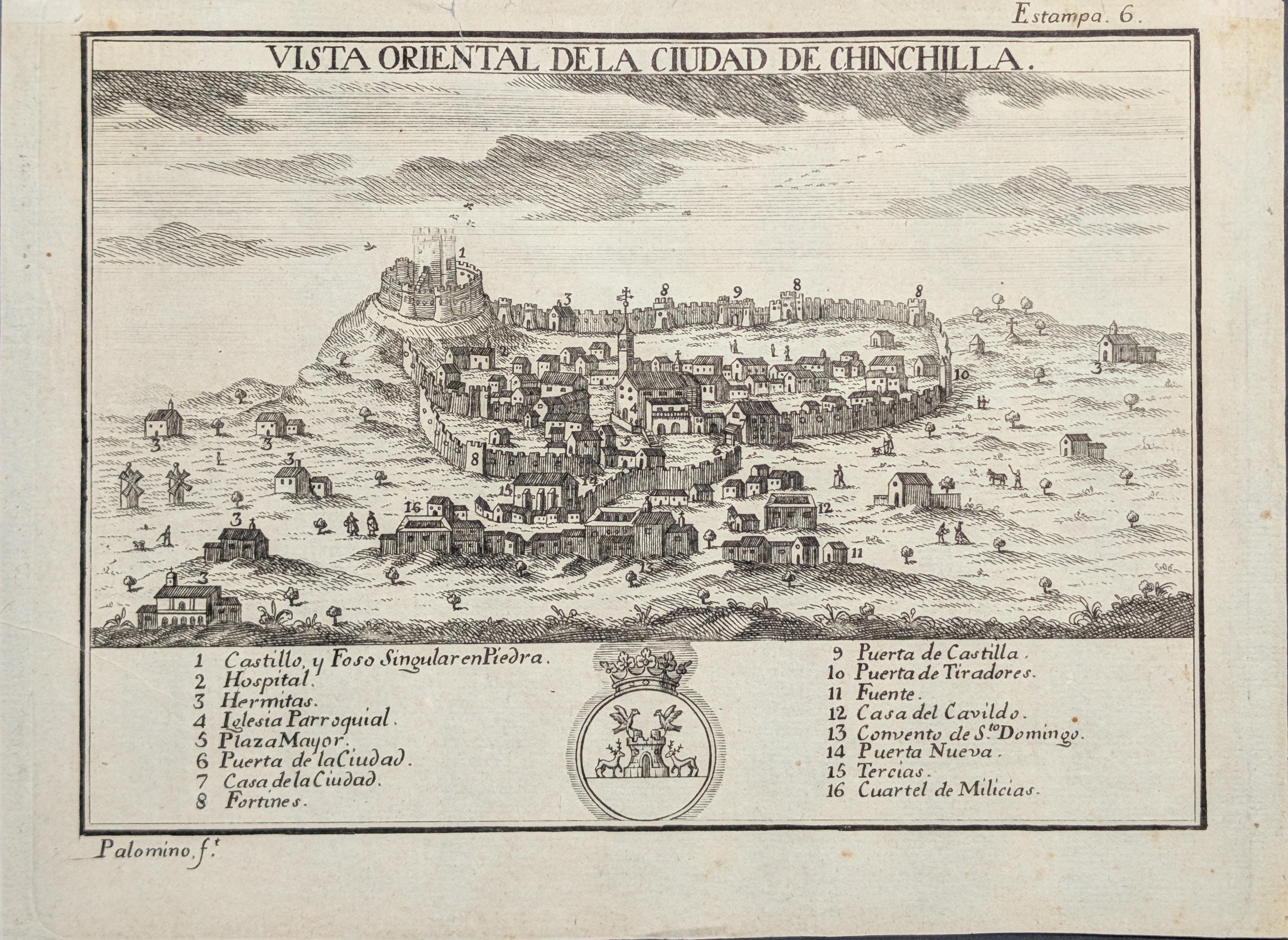
Esta vista antigua original de la ciudad de Chinchilla de Montearagón (Albacete), titulada "Vista oriental de la ciudad de Chinchilla", fue diseñada y publicada por el geógrafo Bernardo Espinalt y García en Madrid en 1783. La estampa forma parte de su destacada obra Atlante Español, un proyecto pionero en la documentación visual y geográfica de la España ilustrada. Este grabado en cobre original captura con gran detalle la imponente situación de la ciudad, erigida sobre un cerro estratégico, y constituye un documento histórico muy interesante para el estudio del urbanismo castellano-manchego del siglo XVIII.
La composición ofrece una perspectiva desde el oriente que enfatiza el carácter defensivo de la ciudad. Una detallada leyenda numerada (del 1 al 16) permite identificar los elementos más significativos de su patrimonio: en la cima, el imponente Castillo (y Foso singular en piedra), seguido de la Iglesia Parroquial (Santa María del Salvador) y la Plaza Mayor. El grabado detalla con minuciosidad las diversas puertas de la muralla, como la Puerta de la Ciudad, la Puerta de Castilla y la Puerta de Tiradores, así como edificios civiles y religiosos de importancia, entre ellos el Convento de Santo Domingo y el Cuartel de Milicias. La presencia del escudo de la ciudad en la base y la representación de las ermitas dispersas por el paisaje circundante dotan a esta vista antigua de una gran riqueza informativa y estética, ideal para coleccionistas de iconografía histórica de Castilla-La Mancha.
Pequeños defectos, que no afectan a la estampa, en el margen superior de la vista.
This original antique view of the city of Chinchilla de Montearagón (Albacete), titled "Vista oriental de la ciudad de Chinchilla", was designed and published by the geographer Bernardo Espinalt y García in Madrid in 1783. The print is part of his prominent work Atlante Español, a pioneering project in the visual and geographical documentation of Enlightenment-era Spain. This original copperplate engraving captures in great detail the city’s commanding position atop a strategic hill, serving as a very interesting historical document for the study of 18th-century Castilian urbanism.
The composition offers an eastern perspective that emphasizes the city's defensive character. A detailed numbered key (1 through 16) identifies the most significant elements of its heritage: at the summit, the imposing Castle (and unique rock-cut moat), followed by the Parish Church (Santa María del Salvador) and the Plaza Mayor. The engraving meticulously details the various gates of the city walls, such as the City Gate, the Castile Gate, and the Tiradores Gate, as well as important civil and religious buildings, including the Convent of Santo Domingo and the Militia Barracks. The inclusion of the city’s coat of arms at the base and the depiction of various shrines scattered across the surrounding landscape imbue this antique view with immense informative and aesthetic value, making it ideal for collectors of historical iconography from the Castilla-La Mancha region.